
Long-Form vs. Short-Form Content: What Converts Best?

Content marketing continuously debates long vs short content. Is it worth publishing lengthy, detailed articles? Or are short, quick-read posts better? Both have merit. And both can be correct depending on what you are trying to achieve.
The goal dictates the format you choose. That’s where you achieve results. Let’s explore further.
What Is Short-Form Content?
Short-form content is fast to read. That is the upside. The downside is that it can be skipped just as fast. Social media posts, blog posts under 1,000 words, email newsletters, and product descriptions all count as short-form. A tweet’s shelf life is about 18 minutes. After that, it is pushed down and forgotten in the feed.
The big wins with short-form:
- Fast to create and easy to share
- Readers get the info without a big time commitment
- Spreads fast on social platforms
- Works great for simple, direct questions
Short-form keeps your brand visible every day. People love fast answers. They click, scan, grab what they need, and move on. That’s just how most readers operate today.
The downside? Short content is easy to forget. It rarely builds deep trust. And you have to keep putting it out constantly to stay relevant.
What Is Long-Form Content?
Long-form content is content that goes deep. These types of content can range from blog posts, white papers, guides, and tutorials to podcasts, which are usually 1,000 words or more. Some content experts even say that, for search rankings, it should ideally be around 3,000 words or more.
The big wins with long-form:
- Ranks much higher in Google search results
- Builds real trust and shows your expertise
- Earns backlinks from other sites
- Keeps readers on your page way longer
The data is pretty clear. Top Google results average around 2,000 words or more. Long-form content gets about 56% more than short-form content. And long-form has a 30% higher conversion rate. That’s not a small gap. That’s a real advantage.
So Which One Converts Better?
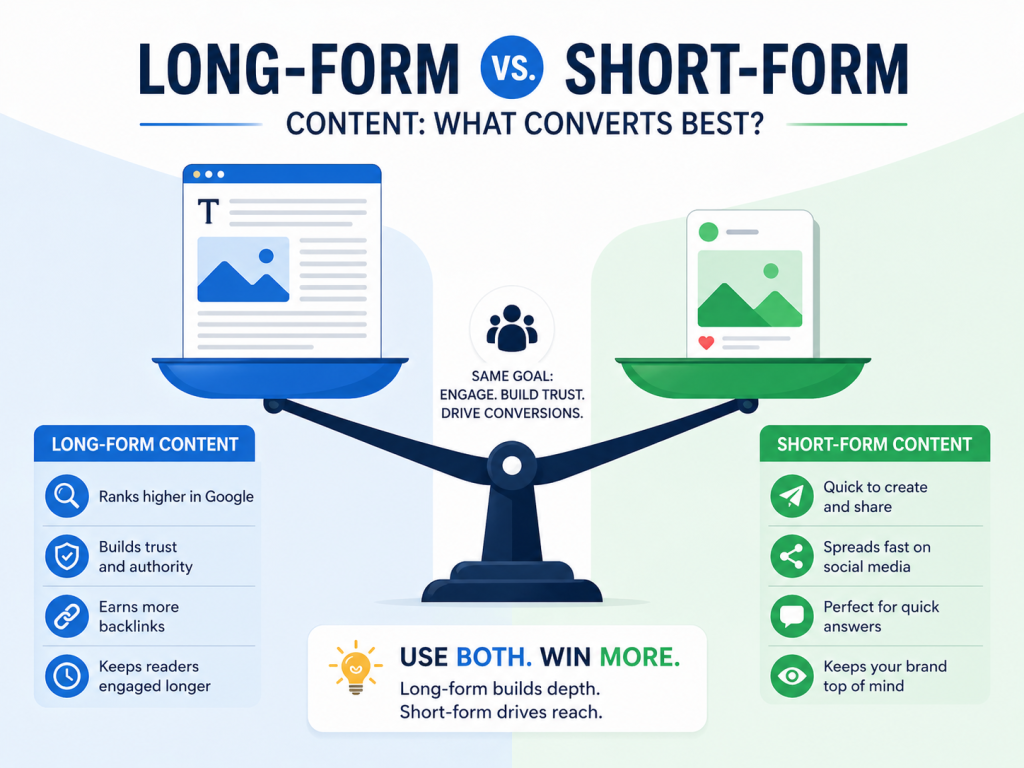
Long-form wins on conversions. Full stop. It keeps readers on your page 40% longer. It also nudges them to browse 25% more pages on your site. More time on your page builds trust. More trust leads to more sales.
Short-form wins on reach and speed. It spreads fast, gets clicks, and keeps your brand fresh in people’s daily scroll.
Picture it this way. Long-form is the foundation of your house. Short-form is the fresh coat of paint you keep adding to stay looking good. You need both for the house to stand.
When Should You Use Each?
Your content should suit the reader’s momentary needs. How much information do they need right now?
Take, for instance, someone searching for the query, “how long to cook chicken.” They should be given a quick, concise answer. Short-form content is the way to go. However, if someone is searching for “best project management tools for small teams,” they need detailed information. They want comparisons and assurance that this is a worthy investment. Long-form content is the way to go in this case.
Here are some simple rules:
- Use short-form for social media, emails, product descriptions, and FAQ pages
- Use long-form for tutorials, guides, white papers, and comparison articles
- Always match the content length to what the reader is actually hunting for
Use Both Together
The best content plans mix both formats. You can start by writing one solid and in-depth long-form post or guide. Then pull the best facts and quotes from it. Turn those into short social posts, email snippets, or quick videos to spread around.
Your long-form content feeds your short-form content. The long piece does the heavy lifting for search rankings. The short posts give you daily reach and visibility. And so both depend on one another.
Start With Pillar Posts
If you are not sure where to begin, you can try building pillar posts first. These are your comprehensive guides to core topics. At least 2,000 words each. They stay useful for years because the info stays fresh and relevant.
Write five or ten of these first. They do most of the heavy lifting in Google. Then fill the gaps with shorter content over time. That combo works really well.
Final Thought
For visibility, opt for short-form content. For trust and conversion, go for long-form. When used in isolation, short and long forms still leave gaps. So you need to use both short and long forms. Prioritize the reader in your writing. The reader’s needs should dictate your writing format.